

You are staring at a blank Google Doc, trying to outline a pillar page about “Digital Marketing.” You know the broad topic, but you have no idea what specific questions your audience is actually typing into the search bar. You spend an hour manually clicking the “People Also Ask” boxes on Google, copying and pasting questions one by one into a spreadsheet. It is tedious, it is slow, and you are missing the bigger picture of how these questions connect to one another.
AlsoAsked is the specialized research tool designed to automate this entire discovery process. Unlike traditional keyword tools that give you a list of phrases and search volumes, AlsoAsked scrapes live “People Also Ask” (PAA) data and organizes it into a visual map. It shows you the hierarchy of a user’s curiosity—starting with a broad question and branching out into the specific follow-up queries that Google knows users ask next. It is the closest thing to a “search intent map” available for content strategists today.
In this AlsoAsked review, we will cover features, pricing, pros, cons, and alternatives.
Quick Verdict — “Tiny Tool Take”
AlsoAsked is a surgical instrument for content planners who want to dominate the “Information” stage of the marketing funnel. It is the gold standard for mapping out topical authority, though it remains a premium add-on rather than a complete SEO suite.
Who this is for: Content strategists, SEO copywriters, and agency teams who need to build comprehensive content briefs and topic clusters.
Who it is NOT for: SEOs who only care about backlink data or technical audits, or small bloggers who need a free, all-in-one keyword tool.
Rating: 4.7/5 ⭐⭐⭐⭐⭐
Key Features
Visual Intent Mapping
The most famous feature of AlsoAsked is its interactive “tree” diagram. When you enter a seed keyword, the tool doesn’t just give you a list; it shows you how questions branch off from each other.
This matters because it reveals the natural progression of a user’s search journey. By seeing which questions are “nested” under others, you can structure your blog posts with subheadings that follow the exact path Google expects a user to take.
Live PAA Data Scraping
Many SEO tools use historical databases that might be months old. AlsoAsked performs live, real-time scrapes of Google’s search results for every query.
This is critical for trending topics or breaking news. If a new algorithm update or a global event changes what people are asking, AlsoAsked will show those new questions immediately, while traditional databases are still catching up.
Deep Search (Lite & Pro Plans)
While a standard search gives you a great overview, “Deep Search” goes layers further into the rabbit hole. It simulates a user clicking through multiple levels of PAA boxes to find highly specific, long-tail questions.
These are often “zero-volume” keywords that traditional tools ignore but that actually drive highly qualified traffic. If you want to find the gaps your competitors missed, Deep Search is the way to do it.
Bulk Search and API
For agencies managing dozens of clients, searching one keyword at a time is not efficient. AlsoAsked allows you to upload a CSV of up to 1,000 keywords and get a massive data dump of all related questions.
The API integration takes this further, allowing enterprise teams to pull live question data directly into their own internal content dashboards or AI writing tools. It turns manual research into a scalable system.
Ease of Use
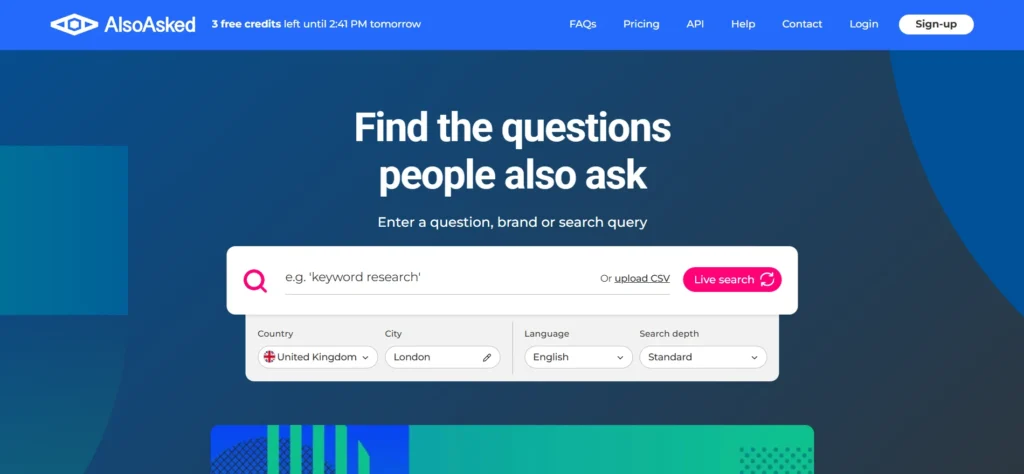
The dashboard clarity is one of the best in the industry. The interface is minimalist and focused entirely on the search bar. Once a search is complete, the visual graph is clean, easy to navigate, and even “presentation-ready” for client meetings.
The setup process is nonexistent. You don’t need to connect your website or upload any data to get started. You simply type in a term, select your target region and language, and hit search. It is one of the few professional SEO tools you can master in under 60 seconds.
The learning curve is essentially flat. While there are advanced settings for history and exports, the core value of the tool is delivered instantly. The hardest part is simply deciding which of the hundreds of questions to prioritize in your content.
Performance & Reliability
Speed is impressive, especially considering the tool is performing live scrapes. Most searches return a full visual map in under 10 seconds. Even Deep Searches, which require more interaction with Google’s SERPs, are completed quickly.
The stability has improved significantly since the tool’s early “alpha” days. In 2026, crashes are rare, and the platform handles bulk uploads with high reliability. The “Search History” feature also ensures that if you do lose your connection, your results are saved and ready to be re-downloaded.
Output quality is as high as it gets because the data is coming directly from Google. You aren’t seeing what an AI “thinks” people might ask; you are seeing the exact questions Google is currently displaying to real users.
Pricing & Plans
AlsoAsked uses a credit-based subscription model. One search (even a Deep Search) typically costs one credit.
| Plan | Price (Monthly) | Credits | Key Features |
| Basic | $15 | 100 | PNG exports, 24hr history, All regions |
| Lite | $29 | 300 | CSV exports, Deep Search, 1-month history |
| Pro | $59 | 1,000 | API Access, Bulk Search, 1-year history |
Note: You can save roughly 20% by opting for an annual subscription.
Pros and Cons
✅ Pros
- Provides the most accurate map of user search intent available.
- Real-time data ensures you are always targeting current questions.
- Beautiful visual exports that are perfect for client pitches.
- Supports city-level local search for specific targeting.
- Unlimited users on all plans, making it great for teams.
❌ Cons
- CSV data exports are locked behind the $29/month Lite plan.
- Does not provide search volume or keyword difficulty metrics.
- Focused strictly on questions; you still need a general SEO tool.
Customer Support
The support at AlsoAsked is highly personal. Because it is a smaller, specialized team, you often get responses from people who deeply understand the product. They offer a comprehensive Help Center and a fast email-based support system.
For Pro users, the API documentation is thorough and well-maintained. The founder, Mark Williams-Cook, is also very active in the SEO community, often sharing tips on how to maximize the tool’s data for better rankings.
Top Alternatives
AnswerThePublic
AnswerThePublic is the most famous alternative. It uses Google Autocomplete data rather than PAA data. While it provides a wider variety of “who, what, where” questions, it doesn’t show the same “intent relationship” between those questions that AlsoAsked does.
Search Response
Search Response is a powerful competitor that offers a “PAA tool” and a “People Also Search For” tool. It provides more data points, like the number of times a question appears in the SERPs, but its interface is less visual and more spreadsheet-heavy than AlsoAsked.
Answer Socrates
If you are on a zero-dollar budget, Answer Socrates is a fantastic free alternative. It combines data from Google Trends, PAA, and Autocomplete. It isn’t as fast or as visually sophisticated as AlsoAsked, but for occasional research, it gets the job done.
Conclusion
AlsoAsked is a mandatory tool for any content marketer who takes topical authority seriously. It solves the “writer’s block” problem by providing a roadmap of exactly what your audience needs to know. By answering the questions found in AlsoAsked, you aren’t just writing a blog post; you are building a resource that Google recognizes as the most helpful answer on the web.
While the lack of search volume data means you still need a tool like Ahrefs or SEMrush to validate your findings, AlsoAsked fills a gap those tools often miss. It is the best way to understand the why behind a search. If your goal is to win Featured Snippets and build deep topical relevance, AlsoAsked is worth every cent of the subscription.
Frequently Asked Questions
AnswerThePublic uses “Autocomplete” data (what Google suggests while you type). AlsoAsked uses “People Also Ask” data (the boxes that appear in the middle of search results). AlsoAsked is generally better for understanding the depth of a topic and how questions are linked.
No. AlsoAsked focuses purely on the questions and their relationships. To see search volume, you would need to export the questions into a CSV (available on Lite plans and above) and upload them to a tool like Ahrefs or Google Keyword Planner.
Yes, they offer a limited free tier that allows for 3 searches per day with PNG image exports only. You will need a paid plan to unlock more searches, CSV exports, or Deep Search.
A standard search looks at the first few levels of PAA boxes. A Deep Search triggers the tool to “click” into those boxes to reveal even more specific, niche questions that aren’t visible at first glance.
Yes. AlsoAsked allows you to specify the country and even the city for your search. This is incredibly useful for local SEO strategies where user questions might vary by region.